

Top News
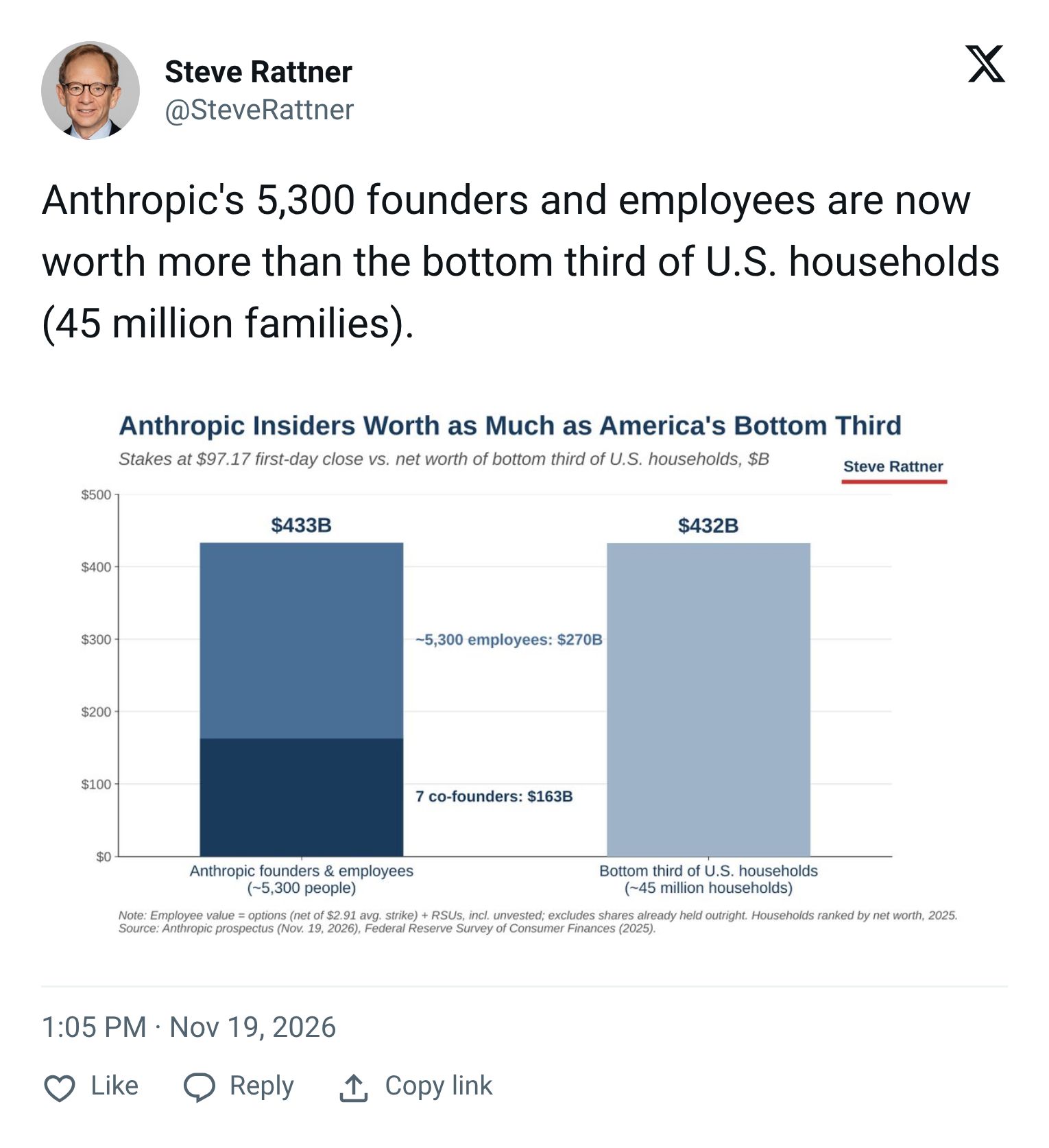
Anthropic’s shares opened at $111.50, 34% above their $83 IPO price, briefly pushing the Claude maker’s market value to $2 trillion and making it the first publicly traded frontier AI company, surpassing SpaceX’s June debut. Reuters has more here.
Anthropic’s IPO could ultimately direct roughly $156 billion to philanthropy, including about $80 billion through its Public Benefit Fund and an estimated $76 billion from employee pledges and company matches, though the final amount will depend on employees following through and Anthropic’s stock price. TechCrunch has more here.
Anthropic’s IPO is delivering enormous returns to venture investors that were willing to write unusually large checks, including Spark Capital, which led a $450 million round in 2023 at a $4.5 billion valuation, and Menlo Ventures, whose $1+ billion investment for a roughly 1.5% stake is now worth over $20 billion. Reuters has more here.
Sponsored By …
Deploying AI in fund ops? You have 3 problems.
1 - security, 2 - accuracy, and 3 - a context window big enough for 1000s of documents. PortfolioIQ solves all three. It extracts every number from documents, maps it to the source, keeps full audit history, and feeds clean data securely to the AI of your choice.
Build on data you can trust → PortfolioIQ.
Anthropic’s 7 Founders Cashed Out Nearly $2B in Record-Breaking IPO

Image Credits: Charly Triballeau / AFP / Getty Images
By Julie Bort
Anthropic became a public company on Thursday, raising a total of $81.3 billion, including $1.95 billion for its seven founders. As we previously reported, each of them ponied up about 3.4 million shares apiece to sell in the IPO.
At the upgraded IPO price of $83 per share, that means they each pocketed about $280 million before underwriting fees and taxes. It looked like they had calculated the number of shares they planned to sell to give them each around $250 million if shares hit $74. That was the midpoint price from Anthropic’s original price range. So that’s a cool $30-ish million more for each of them than perhaps they were gunning for.
Anthropic implied in its IPO filings that the founders aren’t entirely in this for the money though. The company said that each of the founders has pledged to dedicate 80% of their personal equity in the company to philanthropy.
However, if any of them struggle to live on their quarter of a billion, they can scale back their charitable commitments. The company points out that these commitments are “voluntary, revocable expressions of each co-founder’s philanthropic intent and do not constitute legally binding obligations.”
With the IPO in the record books, there were a few other interesting numbers worth highlighting.
$104.8 billion. That’s really the amount Anthropic raised for its coffers (with a possibility of $117 billion, if the bankers buy all of their allotment of shares). In addition to selling its Class A common stock, it also sold a previously announced $26 billion worth of a special non-voting Class N stock to some of the biggest tech names in the industry.
Massive Fundings
Ansa Biotechnologies, an eight-year-old startup based in Emeryville, CA, that produces long, complex synthetic DNA for drug discovery, vaccines, cell and gene therapies, and biological research, raised a $71.5 million Series C round led by Blue Water Life Science Advisors, with Illumina Ventures, BEVC, Lightscape Partners, and Agent Capital as well as previous investors Cerberus Ventures, Fall Line Capital, Dauntless Ventures, and Altitude Life Science Ventures also stepping up. The company has raised a total of $211 million. More here.
Boltz, a one-year-old London startup that develops AI models that help drug researchers design molecules and select candidates for laboratory testing, raised a $110 million Series A round led by Bessemer Venture Partners, with Benchling as well as previous investors Andreessen Horowitz, Amplify Partners, Zetta Venture Partners, Obvious Ventures, Greycroft, F-Prime Capital, and Hummingbird also taking part. The company has raised a total of $138 million. More here.
Linq, a seven-year-old San Francisco startup that provides messaging, voice, and computer-use infrastructure that lets AI agents communicate, operate software, and complete tasks, raised a $90 million Series B round led by Andreessen Horowitz, with additional support from Anthos and Left Lane Capital as well as previous investors TQ Ventures, Mucker Capital, and Abstract. The SaaS News has more here.
MegaRobo, a 10-year-old Beijing company that builds robotic systems for AI-driven scientific experiments and precision manufacturing, raised a $200 million round. Investors included Oman Investment Authority, Asia Investment Capital, Granite Asia, Sinovation Ventures, and CMB International. The company has raised a total of $600 million. SiliconANGLE has more here.
Big-But-Not-Crazy-Big Fundings
Everful, a two-year-old San Francisco and Singapore startup that connects smaller retailers and brands with Chinese factories and manages sourcing, quality control, and logistics, raised a $48.5 million Series A co-led by Vertex Ventures Southeast Asia & India and January Capital, with previous investors Square Peg and Lightspeed also stepping up. TechCrunch has more here.
Nodal Networks, a two-year-old Los Angeles startup that develops AI tools that help container terminals predict congestion and plan container placement, equipment allocation, and loading, raised an $11.3 million seed round led by Eniac Ventures, with NewRoad Capital Partners as well as previous investors Riot Ventures, Trail Mix Ventures, and Liquid 2 Ventures also participating. The company has raised a total of $14.5 million. SiliconANGLE has more here.
StepSecurity, a five-year-old Seattle startup that detects and blocks malicious code across developer machines, code repositories, package registries, and software deployment workflows, raised a $20 million Series A round led by Elephant, with previous investors Runtime Ventures, Inner Loop Capital, and SaaS Ventures also anteing up. The company has raised a total of $23 million. More here.
Smaller Fundings
LATO, a London startup founded this year that uses AI agents to interview customers and industry experts for investment firms conducting commercial due diligence, raised a $4.7 million seed round co-led by Air Street Capital and Axiom Partners, with additional participation from Y Combinator, Montis VC, Inception Fund, and Paul Graham. Tech Funding News has more here.
Tesorai, a two-year-old San Diego startup that uses AI to reprocess raw life sciences data so researchers can search and compare findings across experiments, raised a $5.3 million seed round. Investors included Perplexity Fund, IQT, South Central Ventures, New Stack Ventures, NextGen Venture Partners, f7 Ventures, VitalStage Ventures, and ZAKA. The company has raised a total of $8 million. Tech Funding News has more here.
Wilgot, a two-year-old Stockholm startup that rewrites brands’ product pages, feeds, and FAQs so AI shopping assistants can understand and recommend their products, raised a $3 million seed round led by Industrifonden, with Luminar Ventures, Foundry Ventures, Ventures Together, and Inovexus also chiming in. Tech.eu has more here.
Sponsored By …
Is Peacebuilding Effective Altruism's Missing Opportunity?
Effective altruism asks where each dollar can do the most good. Conflict doesn't just cost lives. It can erase years of progress in health, education, and economic development. Yet conflict prevention remains overlooked and underfunded.
The International Fund for Peace is developing a model combining local knowledge, technology, and stronger institutions to identify risks early and help prevent violence. Join us in building the peace infrastructure. Robert J. Berg, Chair, IF4Peace.org
New Funds
Mudita Venture Partners, a six-year-old Detroit VC firm that backs early-stage AI-first B2B software companies, raised a $120 million second fund, three times the size of its debut vehicle. More here.
Exits
Intuit has agreed to sell Mailchimp to Italian tech consolidator Bending Spoons for $3.68 billion, less than one-third of the roughly $12 billion it paid for the email-marketing company in 2021. CNBC has more here.
Kraken parent Payward agreed to acquire eight-year-old Tribe Capital, the $2.6 billion venture firm founded by and chaired by Kraken co-CEO Arjun Sethi, for an undisclosed sum. Tribe began investing in Kraken in 2020 and became its second-largest institutional investor. CoinDesk has more here.
Going Public
More than half of the roughly 1,200 institutional investors that sought shares in Anthropic’s blockbuster IPO received no allocation, with shares heavily skewed toward U.S.-based buyers and many overseas orders shut out entirely. Bloomberg has more here.
Anthropic’s IPO will make it by far the largest publicly traded public benefit corporation, testing an unusual governance structure that requires the company to balance shareholder returns with its mission to develop AI safely, while its seven founders retain 50.1% of voting control and an independent trust can appoint several board members. The New York Times has more here.
People
Anthropic CEO Dario Amodei used the company’s Nasdaq debut to pledge that Anthropic will pace the training and deployment of AI systems for as long as necessary to ensure they are safe and remain under human control, saying it will not bend to business or political pressure. TechCrunch has more here.
Facebook co-founder Dustin Moskovitz, one of Anthropic’s earliest investors, argues that “A.I. is moving too fast” and says frontier labs should stop racing, even as his early stake became worth billions. He transferred the shares to a non-profit in 2025 so he and his wife would not personally profit from the IPO. The New York Times has more here.
Elon Musk says SpaceX has completed the design of miniature rooftop cell towers meant to eliminate indoor mobile dead zones that Starlink satellites can’t reach, with production expected in 2027 alongside a new Direct-to-Cell satellite network designed to increase bandwidth 40-fold. TechCrunch has more here.
Post-Its
Data
JPMorgan chief U.S. economist Michael Feroli says 2026 will likely mark “peak AI” in terms of its contribution to aggregate demand, with AI-related capital spending expected to decline modestly next year; Apollo chief economist Torsten Sløk estimates the boom has accounted for 65% of U.S. GDP growth so far this year. Business Insider has more here.
Essential Reads
Meta’s fast-growing Muse AI agent, downloaded more than 10 million times since September, has repeatedly accessed private messages, fabricated purchase and financial information, and sent users chats that appeared to belong to other people, prompting internal concerns about potential cross-account data leaks. Reuters has more here.
After speaking with dozens of current and former Anthropic employees, New York Times Opinion columnist Jasmine Sun describes a company increasingly consumed by the fear that AI development is moving too fast even as it plans to use its IPO proceeds to buy more computing power and reach recursively self-improving AI before its rivals. More here.
North American companies ordered nearly 11,000 industrial robots in the third quarter, up 25% from a year earlier, as manufacturers turn to automation to address labor shortages; orders for collaborative robots jumped 56%. The Financial Times has more here.
A 70-year-old participant in a Caltech-USC brain-computer-interface study is fighting for access to neural data generated by six chips implanted in his brain after researchers told him the information belonged to them, highlighting the absence of clear U.S. rules governing ownership of brain data. The New York Times has more here.
Detours
The release of Grand Theft Auto VI is prompting a mini workplace blackout, with PTO requests for Nov. 19 running nearly 13% above comparable days and employers ranging from Riot Games to real estate firm Serhant making accommodations for workers eager to play.
Kids are increasingly refusing to smile for school and family photos, favoring blank stares, tiny smirks, “mean-mugging,” and TikTok-inspired poses they consider cooler and less “cringe,” to the frustration of parents and photographers.
RIP, Fiona the Hippo.
Brain Rot
Retail Therapy

Image Credits: Andrew Maness
A loving look at the $500,000+ Ferrari 12Cilindri.
Tips (the non-pecuniary kind)
Please send all of your hot gossip to [email protected] or [email protected].
Want to advertise on StrictlyVC?
To book ads directly, contact us at [email protected].